

A PRACTICAL EXERCISE
Are you sitting down?
How do you feel where you’re currently seated?
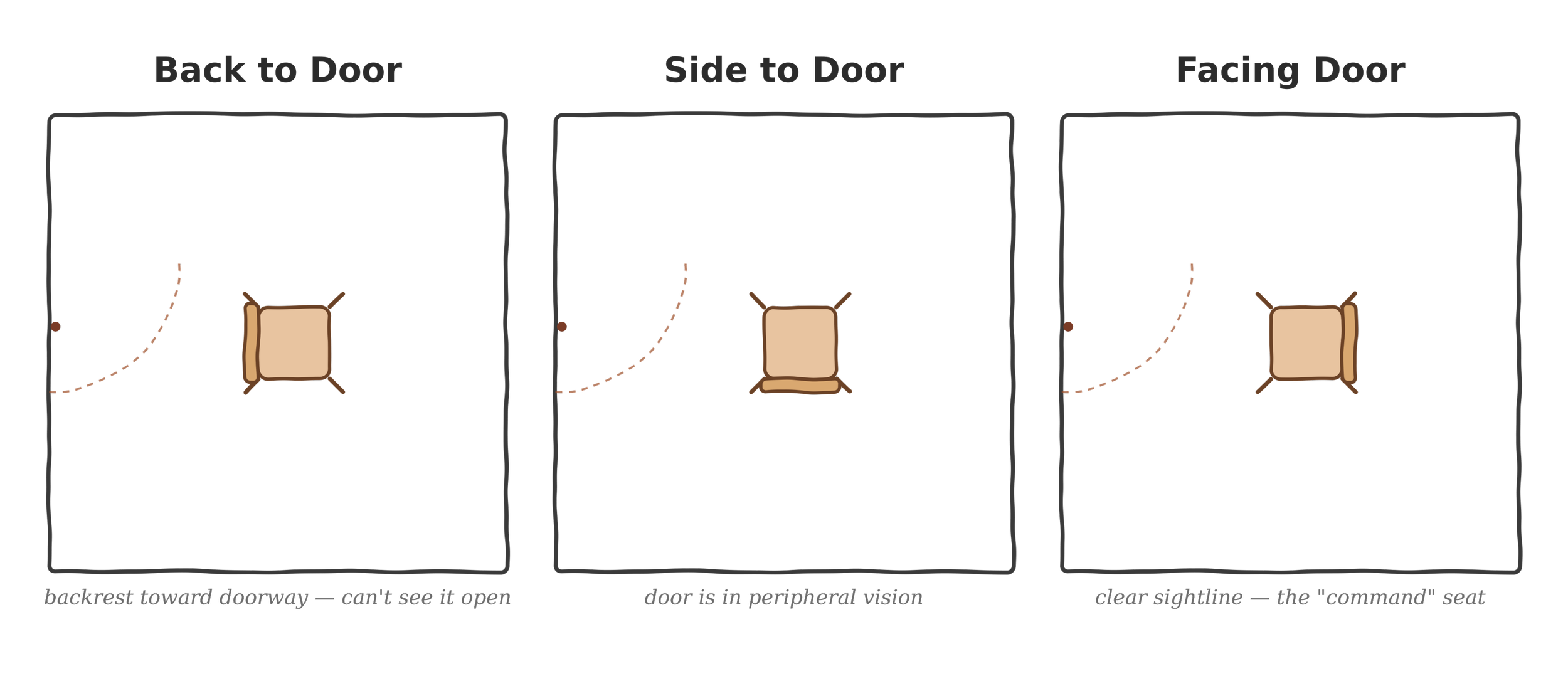
Try these three orientations.
Your seat with the back to the door (or entrance to the space).
Your seat with the side to the door.
Your seat facing the door.
With each one, take a deep breath, settle in, and take note of how you feel.
Different design traditions often use different words for the same idea. BLLIS finds the high impact overlaps that matter most — the ones backed by science and easy to use.
Biophilic Design calls it “Prospect & Refuge”
Our instinct to seek spaces where we can see what’s coming (prospect) while feeling protected from behind (refuge).
Feng Shui calls it “Command Position”
The spot in a room where you can see the door without being directly in line with it— a position that creates feelings of control and ease.
Neuroscience calls it “Peripersonal + Extrapersonal Space Monitoring”
Your brain’s continuous monitoring of two zones — the space immediately around your body, and the wider space beyond it — scanning both for potential threats and anything requiring attention.
Simply put: Where you sit changes how you feel.
When you can see the room and who’s coming in, your brain relaxes. When your back is to the door, your brain stays on guard — working hard in the background, even when you don’t notice it.
BLLIS exists to explore the shortest path to a feel-good space
— and we’re looking to science for stress-reducing and game-changing design guidance.

“It's not the decoration in itself, it's the flow and feeling within the space.”
- Ana, Corporate Lawyer, Lisbon, Portugal
Curious to Learn More?
Let’s explore what’s possible for your space. No pressure, no obligation - just a conversation about your vision and how we might bring it to life.